What Is the Network Prefix Length? A Simple Guide to CIDR and Subnetting
Introduction
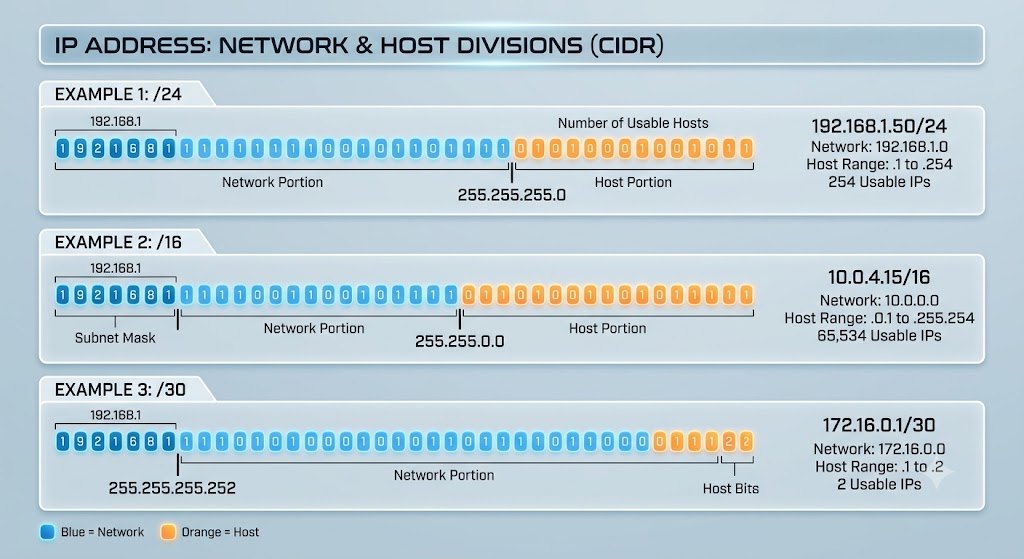
If you’ve ever asked what is the network prefix length, the short answer is: it is the number of bits in an IP address that identify the network portion of that address. In CIDR notation, it appears after a slash, such as /24 in 192.168.1.0/24. The remaining bits are used for host addresses within that network. Understanding network prefix length is essential for subnetting, IP planning, and network troubleshooting.
What Is the Network Prefix Length?
The network prefix length specifies how many bits at the beginning of an IP address belong to the network itself.
For example:
- 192.168.1.0/24
- /24 means the first 24 bits identify the network.
- The remaining 8 bits identify hosts.
Quick Formula
Network Prefix Length = Number of Network Bits
Host Bits = Total Bits − Prefix Length
For IPv4, the total is 32 bits.
Understanding CIDR Notation
Network prefix length is commonly written using CIDR (Classless Inter-Domain Routing) notation.
| CIDR | Subnet Mask |
|---|---|
| /8 | 255.0.0.0 |
| /16 | 255.255.0.0 |
| /24 | 255.255.255.0 |
| /30 | 255.255.255.252 |
Why Network Prefix Length Matters
Prefix length determines how large a network is.
It affects:
- The number of available IP addresses
- Subnetting design
- Routing efficiency
- Network security
- Address allocation
How to Calculate Available Hosts
For IPv4:
Usable Hosts = 2^(32 − Prefix) − 2
Example: /24 Network
- Host bits = 32 − 24 = 8
- Total addresses = 2⁸ = 256
- Usable hosts = 254
Common Network Prefix Lengths
| Prefix | Usable Hosts |
|---|---|
| /24 | 254 |
| /25 | 126 |
| /26 | 62 |
| /27 | 30 |
| /28 | 14 |
| /29 | 6 |
| /30 | 2 |
if you want to know, Optical Network Terminal Box, click here.
Network Prefix Length vs Subnet Mask
These two terms describe the same concept in different formats.
Example
- Prefix length: /24
- Subnet mask: 255.255.255.0
Network engineers often prefer CIDR notation because it is shorter and easier to read.
IPv4 vs IPv6 Prefix Lengths
IPv4
- Uses 32-bit addresses
- Typical prefixes: /24, /16, /30
IPv6
- Uses 128-bit addresses
- Common prefixes: /64, /56, /48
Important
In IPv6, /64 is the standard size for most local networks.
Real-World Example
Suppose a company receives 10.0.0.0/16.
This means:
- 16 bits identify the network.
- 16 bits are available for hosts.
- Total addresses = 65,536.
- Usable hosts ≈ 65,534.
The company can then create smaller subnets such as /24 networks for different departments.
What Is the Network Prefix Length Used For?
Network administrators use it for:
- Designing LANs and WANs
- Configuring routers and firewalls
- Creating VLAN subnets
- Managing cloud networks
- Troubleshooting connectivity issues
- Optimizing IP address usage
How to Read a Prefix Quickly
| Prefix | Meaning |
|---|---|
| /8 | Very large network |
| /16 | Large organization |
| /24 | Typical small network |
| /30 | Point-to-point link |
| /32 | Single IPv4 address |
FAQs
1. What does /24 mean in an IP address?
A /24 means the first 24 bits identify the network. It leaves 8 bits for hosts, allowing 254 usable devices on that subnet.
2. Is network prefix length the same as subnet mask?
Yes. They represent the same information in different formats. For example, /24 equals 255.255.255.0.
3. How do I calculate host addresses from a prefix length?
Use the formula 2^(32 − prefix) − 2 for IPv4. A /26 subnet provides 62 usable hosts.
4. What is the maximum IPv4 prefix length?
The maximum is /32, which represents a single IPv4 address.
5. Why is /64 common in IPv6?
IPv6 networks typically use /64 because many IPv6 features, including automatic address configuration, are designed around that subnet size.
Conclusion
Understanding what is the network prefix length is a fundamental networking skill. It tells you how many bits of an IP address belong to the network and how many are available for hosts. Whether you’re configuring a home router, managing enterprise infrastructure, or studying for networking certifications, mastering prefix lengths and CIDR notation will make subnetting and IP planning much easier.
To deepen your networking knowledge, learn how subnet masks, CIDR notation, and routing tables work together in real-world network design.