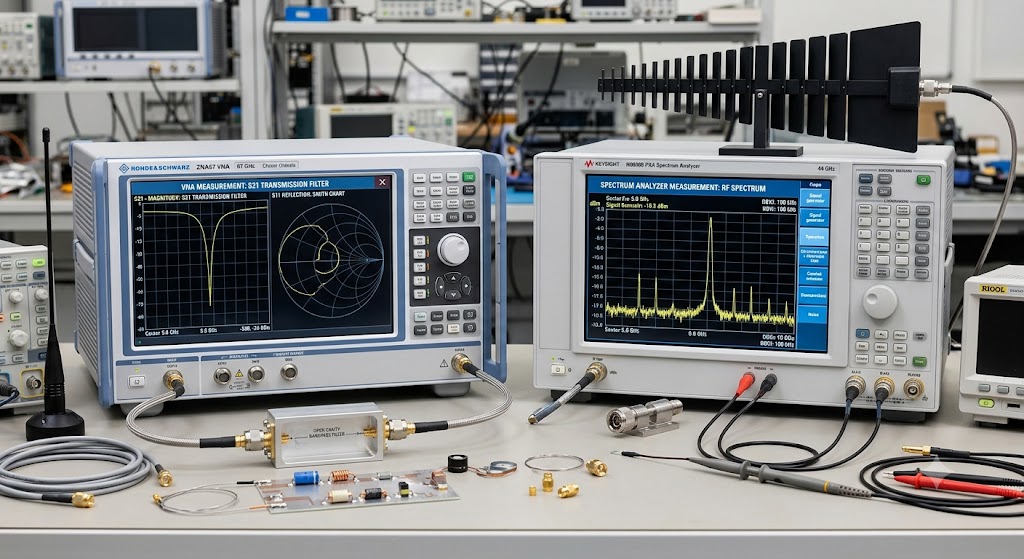
Network Analyzer vs Spectrum Analyzer: Key Differences, Uses, and Which One You Need
Introduction
When comparing network analyzer vs spectrum analyzer, the biggest difference is what each instrument measures. A network analyzer evaluates how an electrical or RF signal behaves as it passes through a device, while a spectrum analyzer measures the strength and frequency distribution of signals already present. Although both are essential tools in RF engineering, telecommunications, and electronics testing, they serve different purposes. Understanding their capabilities helps engineers, technicians, and students choose the right instrument for accurate measurements.
Network Analyzer vs Spectrum Analyzer: What’s the Difference?
At first glance, both devices appear similar because they display frequency-related information. However, their measurement objectives are entirely different.
A network analyzer actively sends a test signal into a device under test (DUT) and measures how the device responds.
A spectrum analyzer, on the other hand, passively observes signals and displays their power across a range of frequencies.
Quick Comparison
| Feature | Network Analyzer | Spectrum Analyzer |
|---|---|---|
| Primary Purpose | Measures device performance | Measures signal spectrum |
| Signal Source | Generates its own test signal | Measures existing signals |
| Main Measurements | S-parameters, impedance, return loss | Frequency, power, harmonics, noise |
| Typical Applications | RF component testing | Signal analysis and troubleshooting |
| Device Under Test | Required | Not always required |
What Is a Network Analyzer?
A network analyzer is an electronic test instrument used to measure the electrical characteristics of RF and microwave components.
It determines how signals travel through devices such as:
- Filters
- Amplifiers
- Antennas
- RF cables
- Connectors
- Mixers
- Printed circuit boards
Modern Vector Network Analyzers (VNAs) measure both signal amplitude and phase, providing detailed information about component performance.
Common Measurements
Network analyzers measure:
- Return loss
- Insertion loss
- Reflection coefficient
- Impedance
- VSWR (Voltage Standing Wave Ratio)
- S-parameters
- Phase response
- Group delay
These measurements are critical during product development and quality assurance.
What Is a Spectrum Analyzer?
A spectrum analyzer displays the amplitude of signals over a range of frequencies.
Instead of testing a component directly, it analyzes signals generated by transmitters, wireless devices, or electronic equipment.
Spectrum analyzers are commonly used to detect:
- Signal interference
- Harmonics
- Spurious emissions
- Noise
- Carrier frequencies
- Signal bandwidth
- Modulation characteristics
Because they visualize RF energy across the frequency spectrum, they are invaluable for diagnosing communication systems.
How Each Instrument Works
How a Network Analyzer Works
A network analyzer generates a precisely controlled RF signal.
The signal travels through the device under test, and the analyzer measures:
- Reflected signals
- Transmitted signals
- Signal phase
- Signal loss
It compares the transmitted and received signals to calculate performance metrics.
How a Spectrum Analyzer Works
A spectrum analyzer receives incoming RF energy through an input connector or antenna.
It separates signals by frequency and displays:
- Frequency on the horizontal axis
- Signal power on the vertical axis
This allows users to quickly identify unwanted emissions, interference, or abnormal signal behavior.
if you want to know, Which AI to Use for Coding?, click here.
Typical Applications
Network Analyzer Applications
Network analyzers are commonly used in:
- RF circuit design
- Antenna development
- Wireless product testing
- Cable characterization
- Filter verification
- Microwave engineering
- Aerospace systems
- Defense electronics
Spectrum Analyzer Applications
Spectrum analyzers are widely used for:
- Wireless network troubleshooting
- Cellular communications
- Broadcast engineering
- Satellite communications
- EMC and EMI testing
- Radio frequency monitoring
- Signal interference detection
- Audio frequency analysis
Advantages of a Network Analyzer
A network analyzer provides detailed component analysis that cannot be achieved with a spectrum analyzer alone.
Benefits include:
- Highly accurate impedance measurements
- Complete S-parameter analysis
- Excellent phase measurements
- Precise filter characterization
- Better antenna performance evaluation
- Essential for RF design validation
Its ability to actively stimulate a device makes it ideal for engineering and product development.
Advantages of a Spectrum Analyzer
Spectrum analyzers excel at identifying real-world signal conditions.
Key advantages include:
- Easy visualization of RF signals
- Fast interference detection
- Harmonic analysis
- Noise floor measurements
- Wide frequency coverage
- Excellent troubleshooting capability
These instruments are especially useful for field engineers maintaining wireless communication systems.
Which Instrument Should You Choose?
Choosing between a network analyzer and a spectrum analyzer depends entirely on your measurement goals.
Select a network analyzer if you need to:
- Test antennas
- Measure filters
- Analyze amplifiers
- Evaluate RF components
- Measure impedance
- Characterize transmission lines
Choose a spectrum analyzer if you want to:
- Monitor wireless signals
- Find interference
- Measure transmitter output
- Detect harmonics
- Analyze signal bandwidth
- Troubleshoot communication systems
In many professional laboratories, both instruments are used together because they complement each other rather than replace one another.
Can One Replace the Other?
Although some advanced test equipment combines multiple functions, a standard network analyzer cannot fully replace a spectrum analyzer, and vice versa.
A network analyzer specializes in measuring device characteristics using generated test signals, while a spectrum analyzer specializes in observing existing RF signals. Using the appropriate instrument ensures accurate measurements and reliable test results.
Future Trends in RF Test Equipment
As wireless technologies continue to evolve, test equipment is becoming more powerful and versatile.
Emerging trends include:
- Integrated vector signal analysis
- AI-assisted signal diagnostics
- Higher frequency support for 5G and 6G
- Cloud-based data management
- Portable handheld analyzers
- Automated calibration and testing
These innovations help engineers perform faster and more accurate RF measurements in both laboratories and field environments.
FAQs
1. What is the main difference between a network analyzer and a spectrum analyzer?
A network analyzer measures how an RF component responds to a generated test signal, including parameters like insertion loss and impedance. A spectrum analyzer measures the frequency content and power of existing signals without stimulating the device under test.
2. Can a spectrum analyzer measure S-parameters?
No. Standard spectrum analyzers are not designed to measure S-parameters. These measurements require a vector network analyzer capable of generating test signals and analyzing both amplitude and phase.
3. When should I use a network analyzer?
Use a network analyzer when designing, testing, or troubleshooting RF components such as antennas, filters, amplifiers, cables, or transmission lines. It provides detailed information about signal transmission and reflection.
4. Is a spectrum analyzer suitable for interference detection?
Yes. Spectrum analyzers are widely used to identify interference, harmonics, spurious emissions, and unwanted RF signals in wireless communication systems, making them an essential troubleshooting tool.
5. Do RF engineers use both instruments?
Yes. Most RF engineers and testing laboratories use both network analyzers and spectrum analyzers because they perform different but complementary measurements. Together, they provide a complete understanding of RF system performance.
Conclusion
Understanding network analyzer vs spectrum analyzer is essential for selecting the right test instrument for RF and electronic measurements. A network analyzer is the preferred choice for evaluating component performance, impedance, and signal transmission, while a spectrum analyzer is ideal for observing signal frequency, power, and interference. Since each instrument serves a unique purpose, many professionals rely on both to achieve accurate testing and reliable results. As RF technologies continue to advance, mastering these tools will help you build, test, and maintain high-performance communication systems with confidence.