Claude vs OpenAI: Which AI Assistant Is Better in 2026?
Introduction
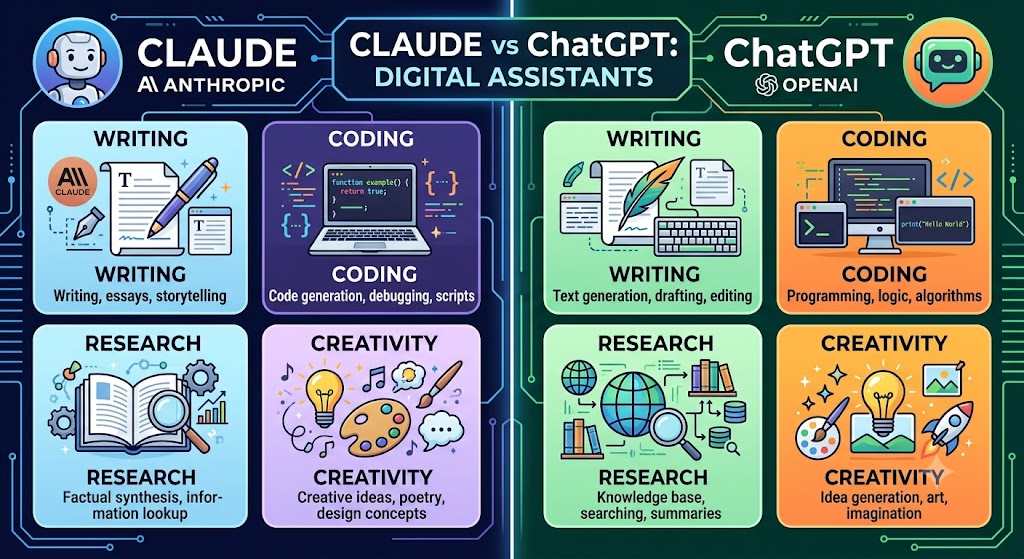
When comparing Claude vs OpenAI, there isn’t a single winner for everyone. Both platforms offer powerful AI assistants, but they excel in different areas. Claude is widely appreciated for handling long documents, thoughtful writing, and careful reasoning, while OpenAI stands out for versatility, coding support, multimodal capabilities, and a broad ecosystem of tools. Choosing the right option depends on your goals, budget, and the type of work you do most often.
H2: Claude vs OpenAI at a Glance
Here’s a quick comparison for readers who want a fast answer.
| Feature | Claude | OpenAI |
|---|---|---|
| Best for | Long-form writing, document analysis | General productivity, coding, creativity |
| Writing Quality | Excellent | Excellent |
| Coding | Very Good | Excellent |
| Image Understanding | Good | Excellent |
| Voice Features | Limited | Advanced |
| API Options | Strong | Extensive |
| Context Window | Very large | Large and capable |
| Ease of Use | Simple interface | Rich ecosystem |
Both platforms continue to improve rapidly, making the competition closer than ever.
What Is Claude?
Claude is an AI assistant developed by Anthropic and designed with a strong focus on helpfulness, reasoning, and safety. It has become popular among professionals who frequently work with lengthy reports, contracts, research papers, and technical documentation.
Many users choose Claude because it can:
- Summarize lengthy documents effectively.
- Generate natural-sounding writing.
- Explain difficult topics clearly.
- Maintain context throughout long conversations.
- Produce thoughtful responses with fewer unnecessary details.
These strengths make it particularly useful for researchers, writers, consultants, and legal professionals.
if you want to know, Education Technology Software Development, click here.
What Is OpenAI?
OpenAI develops ChatGPT and several advanced AI models that support writing, coding, research, brainstorming, data analysis, and image understanding.
One reason OpenAI remains highly popular is its broad feature set. Besides text generation, users can often access capabilities such as:
- Image analysis
- Voice conversations
- File uploads
- Coding assistance
- Data interpretation
- Custom GPTs
- Deep research workflows
This versatility makes OpenAI suitable for both everyday users and enterprise teams.
Claude vs OpenAI for Writing
If your primary task is content creation, both tools perform exceptionally well.
Claude’s Writing Strengths
Claude often produces writing that feels natural and conversational. It performs especially well when:
- Writing long blog posts
- Editing articles
- Rewriting documents
- Summarizing reports
- Maintaining a consistent tone
Many users appreciate that Claude tends to avoid excessive repetition while preserving context over thousands of words.
OpenAI’s Writing Strengths
OpenAI offers greater flexibility across different writing styles.
It performs well for:
- Marketing copy
- SEO content
- Email writing
- Creative storytelling
- Social media content
- Technical documentation
Its ability to switch between tones quickly makes it valuable for content creators working across multiple industries.Claude vs OpenAI for Coding
Developers frequently compare these platforms for programming assistance.
OpenAI generally has an advantage when it comes to coding because it can:
- Generate code quickly.
- Debug complex issues.
- Explain programming concepts.
- Assist with multiple programming languages.
- Help build applications from scratch.
Claude also performs well with software development, particularly when reviewing large codebases or explaining complicated logic. However, many developers prefer OpenAI for day-to-day programming tasks due to its broader development ecosystem.
Reasoning and Problem Solving
Reasoning quality has become one of the biggest differences between AI assistants.
Claude often takes a more structured approach when solving complex problems. It explains ideas carefully and tends to produce balanced answers for analytical tasks.
OpenAI, meanwhile, combines strong reasoning with speed and adaptability. It can handle everything from mathematics and business planning to creative brainstorming and technical analysis.
For most users, both systems provide excellent reasoning, although individual results may vary depending on the prompt.
User Experience and Ease of Use
Both platforms offer clean interfaces that are easy to learn.
Claude keeps the experience relatively minimal, helping users focus on conversations without distractions.
OpenAI provides a broader workspace with additional tools such as:
- Voice interaction
- Image generation
- File analysis
- Custom AI assistants
- Memory features
- Integrations with other workflows
Users looking for an all-in-one productivity assistant often appreciate these extra capabilities.
Pricing and Value
Pricing structures change periodically, but both companies typically offer free and premium subscription options.
When evaluating value, consider:
- Monthly budget
- Usage frequency
- Document size
- Coding needs
- Research requirements
- Business integrations
For casual users, either free plan may be sufficient. Professionals who rely on AI daily often benefit from premium subscriptions that provide faster responses and access to more advanced models.
Which One Should You Choose?
Your decision should depend on how you plan to use AI.
Choose Claude if you:
- Write long reports.
- Analyze large documents.
- Prefer detailed explanations.
- Need consistent long-form writing.
Choose OpenAI if you:
- Want an all-purpose AI assistant.
- Write and code regularly.
- Need image understanding.
- Use voice interactions.
- Value a large ecosystem of productivity tools.
If possible, testing both platforms with your own workflows is the most reliable way to determine which suits your needs.
Final Comparison
Both Claude and OpenAI rank among today’s leading AI platforms.
Claude shines in document analysis, thoughtful writing, and maintaining context across lengthy conversations.
OpenAI offers exceptional versatility, combining writing, coding, research, multimodal capabilities, and productivity tools into one platform.
Ultimately, the better choice depends less on benchmarks and more on your daily tasks.
FAQs
What is the main difference between Claude vs OpenAI?
Claude focuses heavily on long-form reasoning, document analysis, and natural writing. OpenAI provides a broader AI ecosystem that includes writing, coding, multimodal capabilities, research, and productivity features for a wide range of users.
Is Claude better than OpenAI for writing?
Claude is often preferred for lengthy articles, reports, and document editing because it maintains context well. OpenAI, however, offers excellent flexibility across creative, marketing, technical, and SEO writing, making it equally strong for many content creators.
Which AI is better for programming?
OpenAI is generally considered stronger for coding thanks to its extensive programming support, debugging abilities, and developer-focused features. Claude also performs well, especially when reviewing large codebases or explaining complex programming concepts.
Can businesses use both Claude and OpenAI?
Yes. Many organizations use both platforms depending on the task. Claude may be chosen for document-heavy workflows, while OpenAI is often used for software development, customer support, automation, and creative projects.
Is Claude vs OpenAI a clear winner?
No. There is no universal winner. Claude excels in long-context reasoning and document work, while OpenAI offers a more comprehensive feature set. The best choice depends on your specific workflow, priorities, and budget.
Conclusion
The Claude vs OpenAI debate doesn’t have a one-size-fits-all answer because both platforms deliver impressive AI capabilities. Claude stands out for thoughtful writing, long-document processing, and structured reasoning, while OpenAI offers exceptional versatility with powerful tools for writing, coding, research, and multimodal tasks. Before committing to one platform, identify the tasks you perform most often and compare how each assistant fits your workflow. As AI technology continues to evolve, staying informed and testing new features will help you get the most value from whichever platform you choose.